

In this guide
- Step 1: Decide how to publish a book — traditional or self publishing?
- Step 2: How to publish a book in India with a traditional publisher
- Step 3: Self publishing India — what you need to do
- Step 4: Get an ISBN for your book
- Can you publish a book in India for free?
- Step 5: Printing your book — how many copies and at what cost?
- Prepare print-ready files
- Legal deposit and copyright
- Step 6: Sell and distribute the book
- Where Printheal fits in
How to publish a book in India comes down to one early choice: send your manuscript to a traditional publisher, or publish it yourself and pay for editing, design and printing. Both routes end with a printed book that has an ISBN and can be sold in shops and online. This guide walks through each step, from finished manuscript to copies in your hands.
Step 1: Decide how to publish a book — traditional or self publishing?
There are three main routes. The right one depends on how much control you want, how fast you need the book, and how much you can spend.
| Traditional publisher | Self publishing | Assisted (paid) publishing | |
|---|---|---|---|
| Who pays for printing | The publisher | You | You, through a package |
| Who decides cover, price, print run | The publisher | You | Shared |
| Royalty / income | Royalty on each copy sold | All the profit after costs | Depends on the contract |
| Time to print | Often a year or more | Weeks | Weeks to months |
| Hardest part | Getting accepted | Editing, design and selling | Checking what the package really includes |
Many schools, institutions, coaching centres and associations publish their own books because they already know who will buy them. For them, self publishing is usually the simplest and cheapest route.
Step 2: How to publish a book in India with a traditional publisher
If you want an established publisher to take on your book, the process is usually:
- Finish and polish the manuscript. Publishers rarely accept half-finished work from new authors.
- Shortlist publishers that publish your genre. A publisher of school textbooks will not take a novel.
- Read their submission guidelines. Most ask for a synopsis, a sample of chapters and a short author note.
- Submit, then wait. Replies can take months. Some publishers only accept work through literary agents.
- Read the contract carefully. Check royalty rates, rights, the print run and who owns the cover design.
Choosing among the best book publishers in India
There is no single list of the best book publishers in India, because "best" depends on your book. A children's picture book, a medical textbook and a poetry collection each need a different kind of publisher. When you compare publishers, look at:
- books they have published in your subject in the last two or three years;
- whether they sell through bookshops, schools, online stores or all three;
- how they handle editing, cover design and marketing;
- what the contract says about rights, royalties and reprints.
Step 3: Self publishing India — what you need to do
Self publishing in India means you act as the publisher. You hire the people you need and you own every decision. A typical self-published book goes through these stages:
- Editing. At least one round of professional editing and one round of proofreading.
- Cover design. The cover sells the book online and in shops. Use a designer who knows print.
- Typesetting. Laying out the inside pages, fonts, margins and page numbers for print.
- ISBN. A free number from the national ISBN agency (see Step 4).
- Printing. Choosing size, paper, binding and quantity, then ordering copies.
- Selling. Online marketplaces, your website, bookshops, schools or events.
Our prepress team can help with design and typesetting, and checks every file before it is printed.
Step 4: Get an ISBN for your book
An ISBN (International Standard Book Number) identifies your book and its edition. Bookshops, libraries and online stores use it to list and order the book. In India, ISBNs are issued by the Raja Rammohun Roy National Agency for ISBN, under the Ministry of Education.
- You apply online on the official portal, isbn.gov.in.
- The ISBN is free. The government made the process online and free of charge in 2016 (Ministry of Education press release).
- Each format needs its own ISBN — a paperback, a hardbound edition and an e-book are separate numbers.
The ISBN and its barcode go on the back cover and the copyright page, so get it before the cover is finalised.
Can you publish a book in India for free?
Partly. If you are wondering how to publish a book in India for free, here is what really costs nothing and what does not:
| Step | Free? |
|---|---|
| ISBN from the national agency | Yes — free |
| E-book on online platforms | Usually free to upload; the platform takes a share of each sale |
| Traditional publishing | Free for the author — the publisher pays, if they accept the book |
| Editing, cover design, typesetting | Paid, unless you do them yourself |
| Printed copies | Paid — you pay for each copy you order |
So you can publish an e-book with almost no cost, but a printed book always involves printing costs. What you can control is how much each copy costs.
Step 5: Printing your book — how many copies and at what cost?
For self-published authors and institutions, printing is usually the largest single cost. Two methods are common:
- Offset printing — cheapest per copy for larger runs, typically from a few hundred copies upwards.
- Digital printing — best for small runs, proofs and quick reprints.
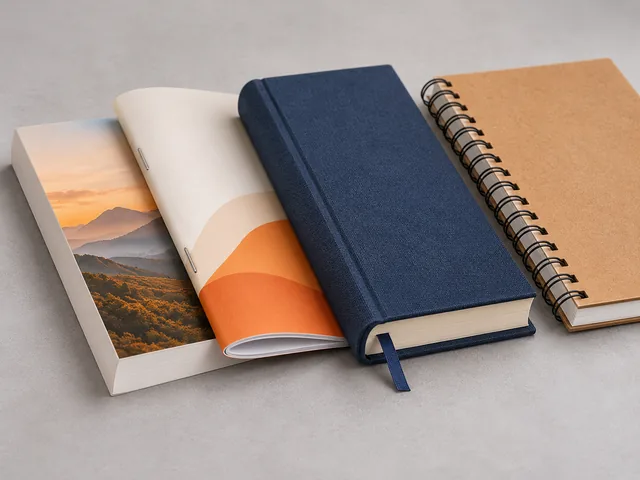
Our guide to offset vs digital printing explains where each one wins. The price per copy depends on quantity, page count, size, paper, colours and binding — the guide to book printing cost in India explains each factor. For textbooks and books that will be read often, choose a binding that lasts; see types of book binding.
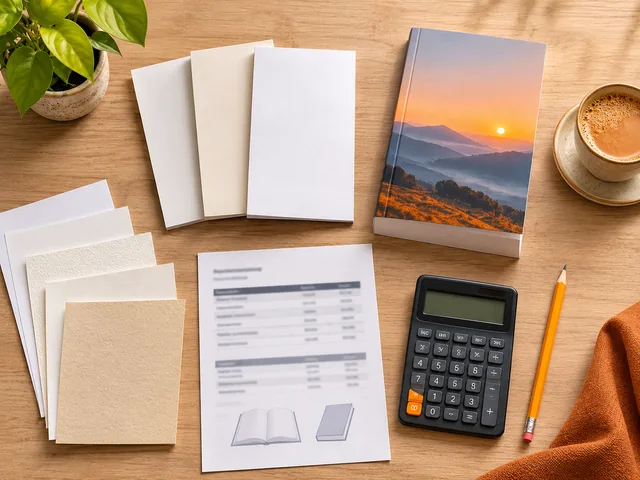
To see a price straight away, use the instant book printing calculator. It shows the price per copy in INR, USD or EUR as you change each option.
Prepare print-ready files
A printer prints exactly what is in your PDF, so small file problems become printed mistakes. Before you send files, check that:
- the page size matches the trim size you ordered, with 3 mm bleed where images run to the edge;
- images are 300 DPI and in CMYK colour, not RGB;
- all fonts are embedded in the PDF;
- the cover spine width matches the final page count and paper thickness;
- the ISBN barcode on the back cover is clear and the right size.
Our prepress team checks every file and sends a proof before anything is printed, so problems are caught early.
Legal deposit and copyright
In India, publishers are required under the Delivery of Books and Newspapers (Public Libraries) Act, 1954 to send a copy of each new book to the national public libraries named in the Act. If you self publish, you are the publisher, so this applies to you. Copyright in your text belongs to you as the author from the moment it is written; you can also register it with the Copyright Office if you want formal proof.
Step 6: Sell and distribute the book
- Online marketplaces — list the printed book with its ISBN.
- Your own channels — website, social media, email list or WhatsApp groups.
- Bookshops and distributors — usually take a discount on the cover price.
- Schools, colleges and institutions — direct bulk sales for textbooks and reference books.
Keep a small stock and reprint when it runs low. With offset printing, a reprint of the same files is quick because nothing needs to be redesigned.
Where Printheal fits in
Printheal Technologies is an ISO 9001:2015 certified printer in New Delhi with two units in Delhi NCR. We print books for publishers, schools, institutions and authors — paperback, section-sewn and hardbound — with prepress, printing, binding and finishing under one roof. We are a printer, not a publisher: you keep your rights and your ISBN. See our book printing page for formats, or contact us with your specification.
 Seasonal
 Pricing
 Binding
 Tax