
In this guide
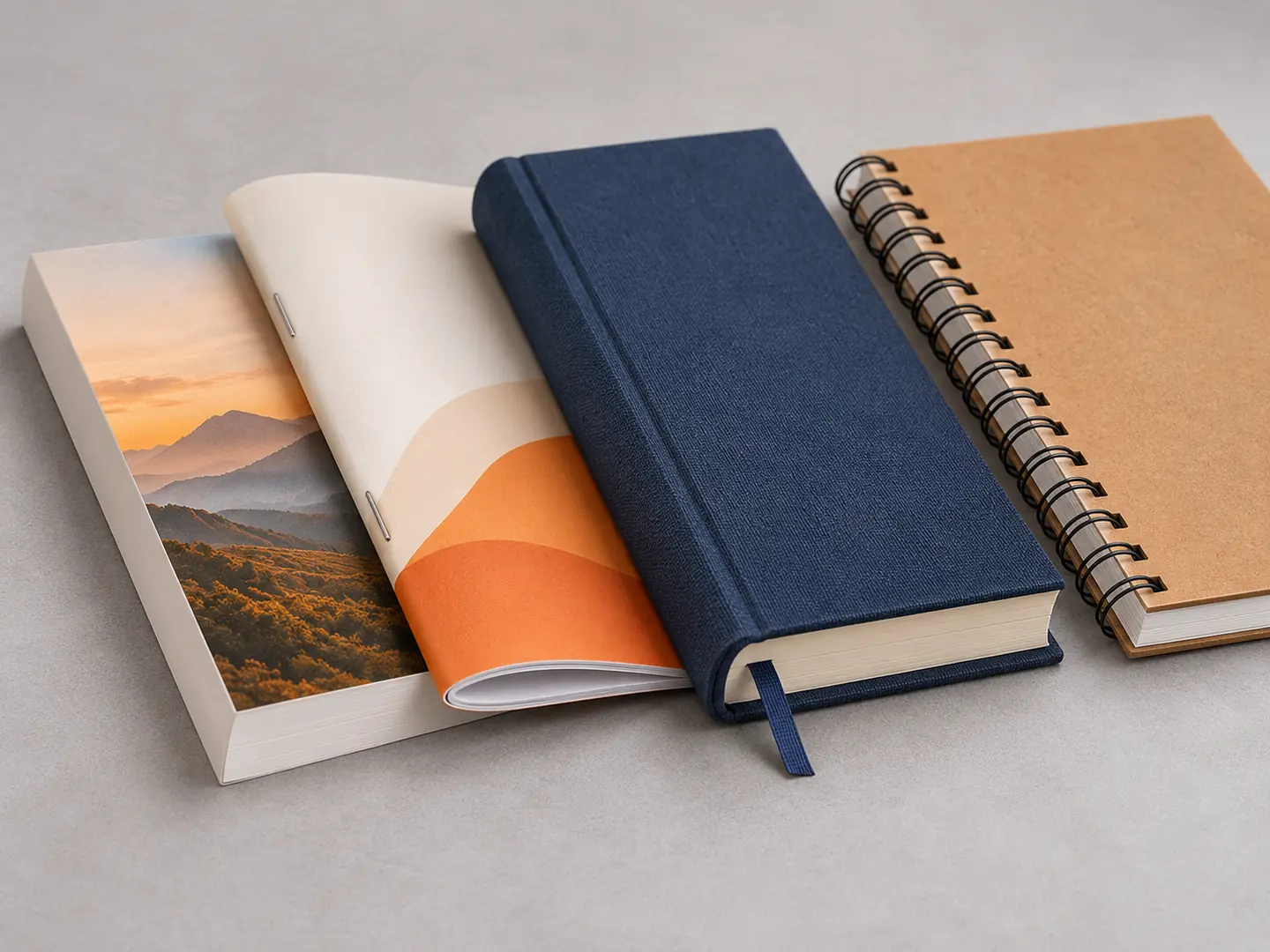
The right book binding type depends on page count, how long the book must last and your budget. Saddle stitch suits thin booklets, perfect binding suits most paperbacks, section sewing suits textbooks, and hardcover suits premium and reference books. This guide compares each one so you can choose with confidence.
What is book binding?
Binding is the step that turns printed, folded sheets into a finished book. After printing, large sheets are folded into sections (also called signatures) of 8, 16 or 32 pages. The sections are gathered in order, joined together and fixed to a cover, then trimmed on three sides.
How the sections are joined is what separates one binding from another. That choice affects how the book opens, how long it lasts and what it costs. At Printheal, printing and binding happen under one roof in our Delhi NCR units, so the binding is planned from the start of the job, not added at the end.
Which book binding type is right for you?
Here is a quick comparison of the five most common types.
| Binding | Page range | Durability | Lies flat? | Relative cost |
|---|---|---|---|---|
| Saddle stitch | 8 to about 64 pages | Light use | Yes | Lowest |
| Perfect binding | 48+ pages | Good | No | Low |
| Section sewn | 48+ pages | Very high | Nearly | Medium |
| Hardcover (case) | 48+ pages | Highest | Nearly | Highest |
| Wiro (wire-o) | Up to a few hundred pages | Good | Yes, fully | Medium |
Two questions narrow the choice quickly. How many pages does the book have? And how long must it last? A 32-page workbook used for one term needs something very different from a 400-page textbook used every day for a year. Budget comes third: once you know which bindings suit the book, pick the most economical one that will survive its real use.
1. Saddle stitch
Folded sheets are nested inside each other and stapled through the spine fold. It is fast and economical, and the book opens flat. Because all pages sit inside one another, it works only up to about 64 pages; beyond that the spine bulges and the inner pages push outwards.
Best for: workbooks, booklets, children's readers, magazines, catalogues and programmes.
2. Perfect binding
The gathered sections are stacked, the spine edge is roughened, and a strong adhesive fixes them into a wrap-around soft cover. The result is a clean, square spine that can carry the title. Our Kolbus and Bindwel perfect binding lines run at high speed, which keeps the cost low on long runs.
Best for: novels, reports, trade paperbacks, journals and textbooks used for a single term.
3. Section sewn
Each section is sewn through its fold with thread, and the sewn sections are then glued into the cover. Thread holds the pages far better than glue alone, so the book survives daily use and opens more freely. It costs a little more than perfect binding.
Best for: school textbooks, curriculum books and reference books that must last a full school year or longer.
4. Hardcover (case binding)
The sewn book block is glued into a rigid case made of board covered with paper, cloth or laminated print. Endpapers join the block to the case. It is the most durable and premium option, and the slowest and most expensive to produce.
Best for: premium editions, yearbooks, coffee table books, reference titles and library books.
5. Wiro (wire-o)
Holes are punched along the spine edge and a double-loop wire is closed through them. The book opens completely flat and can fold back on itself, which is ideal for books used on a desk.
Best for: diaries, planners, desk calendars, manuals and notebooks.
[ Wiro binding in-house or through a finishing partner — Printheal to confirm. ]
Hardcover book printing: when is it worth the extra cost?
Hardcover book printing costs more because it adds steps: making the boards, covering the case, sewing the block, fixing endpapers and casing-in. It also adds weight, which matters for export freight.
It is worth it when the book must last for years, when it will be handled by many readers, or when the book itself is a gift or a statement — a yearbook, an anniversary history or a premium edition. For a novel or a one-term textbook, a well-made paperback usually gives better value.
How binding affects your book printing cost
Binding is only one part of the total, but it changes the price per copy noticeably on long runs. In general the order, from cheapest to most expensive, is: saddle stitch, perfect binding, wiro, section sewn, hardcover. The exact difference depends on page count, size and quantity.
To compare options for your own book, change only the binding in the instant quote calculator and watch the price per copy update. Our book printing cost guide explains the other factors that move the price.
Book printing and binding under one roof
When book printing and binding happen in the same plant, three things improve. First, quality: sections are folded, gathered and bound by the same team that printed them, so errors are caught early. Second, time: there is no waiting for an outside bindery or transport between sites. Third, cost: no extra handling and no middleman margin.
Our binding lines include automatic gathering, perfect binding, section sewing and stitching, plus lamination, UV, spot UV, foil and embossing for covers. See the machines on our infrastructure page and the finishing options on prepress and finishing.
Cover finishes that go with each binding
The cover takes the most wear, so the finish matters as much as the binding. These are the options we offer in-house:
- Gloss lamination. A shiny, wipe-clean film. Colours look bright. Popular for children's books and textbooks.
- Matt lamination. A soft, non-reflective film that resists fingerprints. Popular for novels and premium reports.
- UV and spot UV. A clear coating over the whole cover or only selected areas, such as the title, to make them stand out.
- Foil stamping. Metallic gold, silver or coloured foil for titles and logos — common on hardcovers and yearbooks.
- Embossing. Raised lettering or shapes you can feel, often combined with foil.
For school textbooks, lamination is the most important finish: it protects the cover from moisture and daily handling. Foil and embossing are best kept for premium editions, because each adds a step and a cost.
Matching binding to the job
- School textbook used all year: section sewn, laminated cover.
- Novel or trade paperback: perfect binding.
- Workbook or children's reader under 64 pages: saddle stitch.
- Yearbook, premium or reference book: hardcover.
- Diary, planner or manual used on a desk: wiro.
- Magazine: saddle stitch, or perfect binding for thicker issues.
Tips before you choose
- Check the final page count first. It decides which bindings are possible.
- Allow a wider inside margin (gutter) for perfect-bound and hardcover books, so text is not lost in the spine.
- Ask for the spine width before the cover is designed. It depends on page count and paper thickness.
- For export, consider the weight. Hardcovers and heavier paper add to freight cost.
- Ask for a bound sample or dummy if durability is critical.
Not sure which binding suits your book? Send us the details through the contact page and we will recommend the most practical option. You can also browse our book printing services.
 Seasonal
 Publishing
 Pricing
 Tax